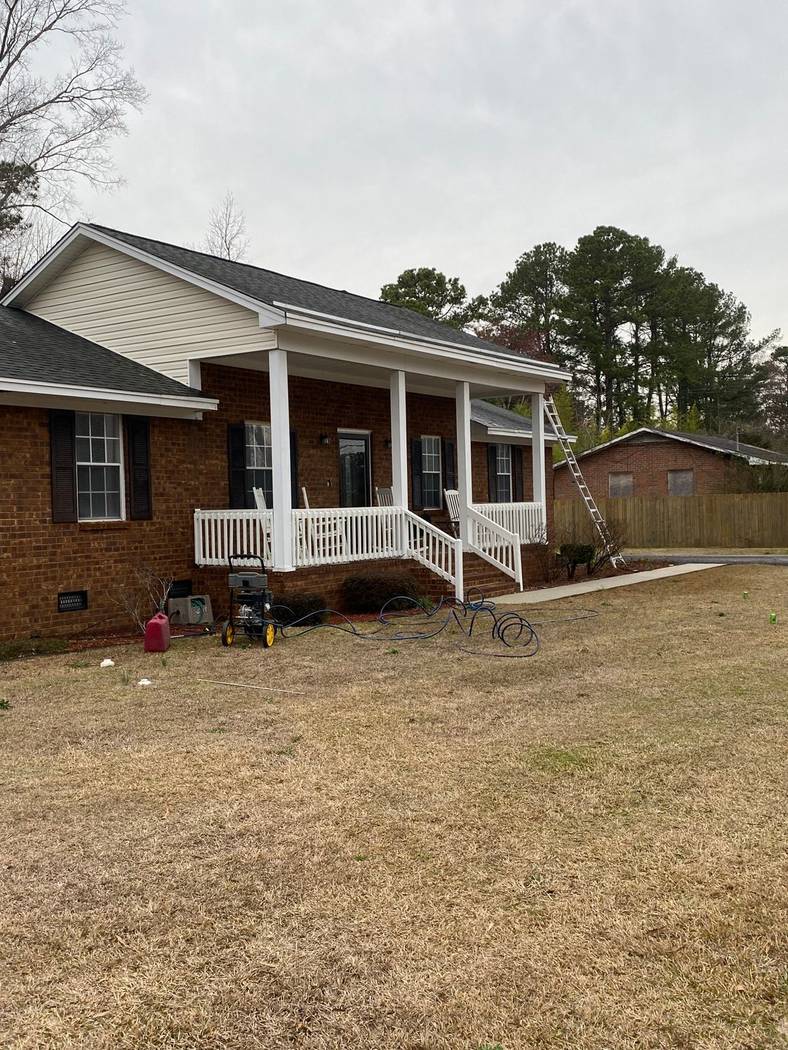
How to Remove Black Streaks from Vinyl Siding: House Washing in Darlington SC
Black streaks on vinyl siding are one of the most common house washing problems in Darlington SC, and they almost always trace back to a single organism rather than ordinary dirt or mildew. If your siding looked fine in June but looks charcoal-streaked by September, here is what is happening and what to do about it.
- The black or dark gray streaking on vinyl siding after a South Carolina summer is almost always caused by a cyanobacterium called Gloeocapsa magma, not dirt or mildew.
- South Carolina's summer humidity creates near-perfect conditions for Gloeocapsa magma to spread, and the streaks tend to look worst in September and October.
- Fall is the right time to wash because the organism is still active and easier to remove before cooler weather pushes it into a dormant, harder-to-lift state.
- Soft washing, which uses low pressure and a cleaning solution, is the appropriate method for vinyl siding because high pressure can force water behind the panels.
- House washing is also the correct prep step before any exterior painting, because paint applied over biological growth will not bond properly and will fail early.
#Why Does Vinyl Siding Look Fine in June but Terrible by September?
You wash the house, and by the following fall it looks like someone dragged a wet mop across the north-facing walls. The streaks are dark, almost charcoal, and they run downward from the roofline or from the soffits. They do not scrub off with a garden hose. This is not something you did wrong. This is biology, and South Carolina's summer gives it everything it needs.
The organism responsible is called Gloeocapsa magma. It is a cyanobacterium, which means it is closer to bacteria than to the algae or mold people usually blame. It feeds on moisture and airborne nutrients and protects itself from ultraviolet light by producing a dark pigmented sheath around its cells. That sheath is what you are seeing on your siding. The organism itself is largely invisible when populations are small. By the time you notice the color, the colony has been growing for months.
#What Makes South Carolina Summer So Favorable for Gloeocapsa Magma?
Gloeocapsa magma thrives when relative humidity stays consistently high, temperatures sit in the warm range, and surfaces stay damp for extended periods. South Carolina delivers all three from roughly May through September. In and around Darlington County, where Lamar, SC sits in the Pee Dee region, overnight humidity barely drops even after a dry day, and north-facing or shaded surfaces can stay damp for hours after sunrise.
Gloeocapsa magma spreads through the air as spores. A neighbor's roof or siding can be a source. Once it lands on your siding and conditions are right, no amount of dry weather will kill an established colony on its own.
The streaking pattern also tells you something useful. Streaks running downward from the roofline usually mean the organism has a foothold on the shingles or in the gutters and is washing down in rain. Streaks that appear uniformly across a shaded wall usually mean the wall itself is the primary colonization site. Knowing the pattern helps you understand what you are dealing with before you decide how to treat it.
#Does Pressure Washing Remove Black Streaks on Vinyl Siding?
Soft washing removes them; high-pressure washing often does not, and it can cause damage in the process. That distinction matters. The surface decides the method, and vinyl siding does not need high pressure and does not tolerate it well. Vinyl panels are designed to breathe slightly. Forcing high-pressure water behind them can introduce moisture to the sheathing underneath, which creates a different problem entirely.
Soft washing uses a pump to apply a surfactant-based cleaning solution at low pressure, lets it dwell, and then rinses. The chemistry does the work, not the force. For Gloeocapsa magma, the active ingredient in most professional soft wash solutions is sodium hypochlorite, diluted to a working concentration appropriate for the surface. It breaks down the dark pigment sheath and kills the organism. The UF IFAS Extension publication library recognizes sodium hypochlorite as effective against cyanobacteria on exterior surfaces when applied correctly.
#Why Is Fall the Right Window for House Washing in Darlington SC?
Fall washing is not just about appearances, though the visual difference is immediate. The timing matters for practical reasons. As temperatures drop and humidity falls through October and into November, Gloeocapsa magma enters a slower metabolic state. The pigment sheath that protects it also becomes more chemically stable and harder to dissolve. Washing in September or early October, when the organism is still metabolically active from the summer, means the cleaning solution works faster and more completely.
There is also a structural argument for acting now. If the streaking has been present all summer, the colony has had months to establish. Waiting through winter means it has more time to penetrate the microscopic texture of the siding surface. It does not destroy vinyl the way it can damage roofing granules, but it does become more physically embedded and harder to lift cleanly by spring.
| Factor | Wash in Fall (Sept-Oct) | Wait Until Spring |
|---|---|---|
| Organism activity level | Still active; cleaning solution works efficiently | Dormant; pigment sheath more chemically stable |
| Colony establishment | Stopped before full winter dormancy locks it in | Additional months of embedding into surface texture |
| Paint prep readiness | Siding is clean and ready if painting is planned | Painting delayed; growth may reappear before it begins |
| Curb appeal through winter | Siding looks clean for months before spring growth | Streaks visible all winter |
#How Does House Washing Fit Into an Exterior Painting Plan?
Professional house washing is the prep step for painting, and skipping it is the most common reason exterior paint fails ahead of schedule. Paint applied over a surface that has Gloeocapsa magma present, even a surface that looks mostly clean, will not bond to the substrate. It bonds to the biological layer instead. That layer eventually lifts, peels, or flakes, and the paint goes with it.
If you are planning to paint the exterior this fall or next spring, the sequence is straightforward: wash first, let the surface dry fully, then prime and paint. Some surfaces need to dry for several days before coating. Others can be ready sooner. The material and conditions determine the timeline.
Run your hand along a streaked section of siding after the surface has been dry for a day. If the dark area feels slightly textured or slightly slick compared to a clean section, the organism is established enough that a simple rinse will not solve it. That is the point where a proper soft wash solution is needed.