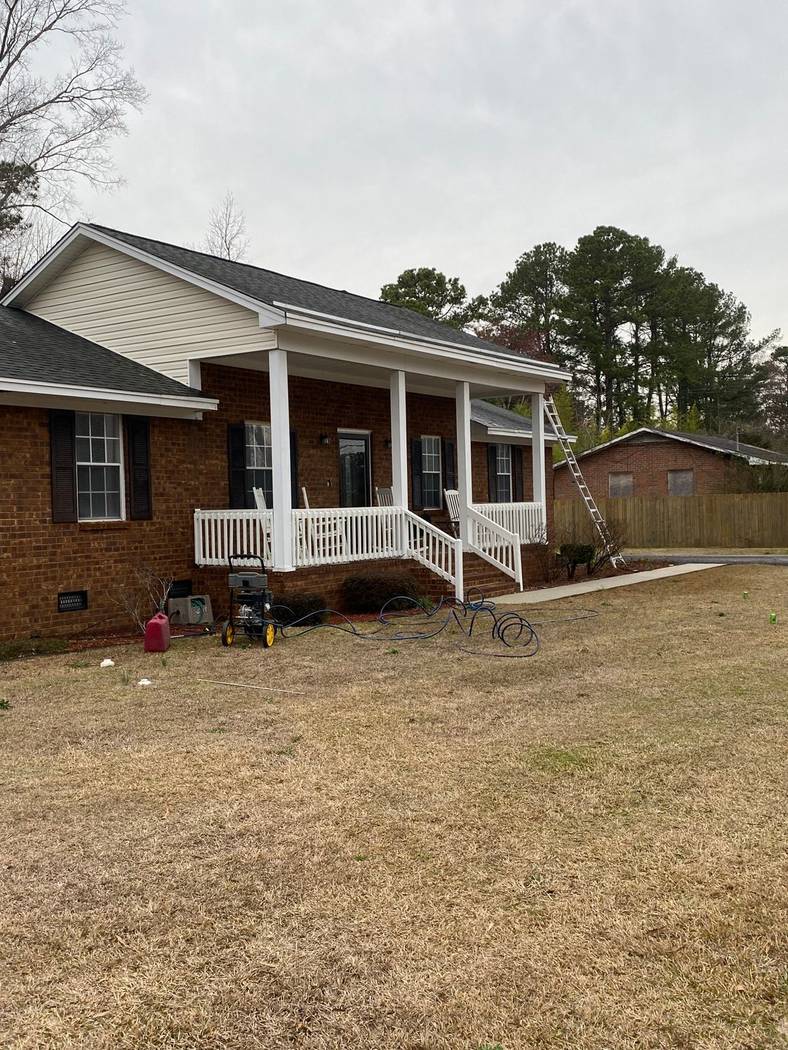
Why Pressure Washing Rust Stains from Irrigation Well Water in Marion SC Leaves Orange Stains Behind
If you've tried pressure washing rust stains from irrigation well water on your Marion SC driveway, you already know the frustrating result: the water sheets off, the stain stays, and once the surface dries it looks exactly the same. That's not a machine-power problem. It's a chemistry problem, and understanding the difference is the only way to actually fix it.
Well water in Marion County and across the Pee Dee tends to carry elevated levels of dissolved iron. When that water runs through an irrigation system and lands on a concrete driveway day after day, the iron oxidizes on contact with air. What is left behind is iron oxide, the same compound most people call rust. It doesn't sit on top of the concrete. It bonds into the calcium silicate matrix of the surface. A pressure washer moves water. It cannot break a chemical bond.
#What Is Actually Happening at the Surface Level?
Concrete looks solid, but under magnification it is full of capillary pores. When iron-rich irrigation water lands and dries repeatedly, dissolved ferrous iron gets pulled into those pores. Once it oxidizes to ferric iron, it becomes insoluble in water. That is the stain.
The color tells you something useful. A bright, almost yellowish-orange stain is usually fresher iron hydroxide. A deeper, brownish-red stain has had more time to convert to a more stable iron oxide form. The deeper and darker it goes, the more it has penetrated the concrete and the more aggressive the treatment needs to be.
Scrubbing an untreated rust stain with a stiff brush accomplishes almost nothing. The iron is not loose particulate matter sitting in pores, it is chemically fixed to the pore walls. Mechanical force alone will not dislodge it.
#Why Does Pressure Washing Alone Fail on Rust?
Pressure washing works by shearing contaminants off a surface using kinetic energy. That works well for algae, mold, dirt, pollen, and even some oil stains, substances that are either sitting on the surface or weakly attached through physical means. Rust is different.
Iron oxide is chemically insoluble in plain water at normal temperatures. Blasting it with high-pressure water does not change that. What you are left with after a thorough pressure wash of a rust-stained driveway is a cleaner driveway with the same rust stains, maybe slightly brighter because surrounding grime has been removed.
The surface decides the method. Rust on concrete is one of the clearest examples: the method has to match the stain's chemistry, not just its appearance.
#What Chemicals Actually Work on Iron Oxide Staining?
The answer is acids. Iron oxide dissolves in acidic solutions because the acid reacts with the iron compound and converts it back to a soluble iron salt that can be rinsed away. Two acids show up most in professional flatwork cleaning for this reason.
| Treatment | How It Works | Typical Use Case | Notes for Applicator |
|---|---|---|---|
| Oxalic Acid | Forms a soluble iron oxalate complex, lifting iron from pores | Light to moderate rust staining on concrete or masonry | Lower risk of etching than stronger acids; usually requires dwell time of several minutes |
| Phosphoric Acid | Reacts with iron oxide to form iron phosphate, which rinses away | Moderate to heavier staining; also used as a concrete prep step before coating | Concentration matters; too strong without dilution can etch the surface |
Both require careful application. You apply the chemical, allow dwell time so the reaction can occur, then rinse with pressure. The pressure wash step at the end is doing real work at that point, removing loosened, now-soluble iron compounds rather than trying to blast away an insoluble one.
Acid treatments on concrete should be used with appropriate protective equipment and neutralized properly. Runoff can affect nearby plantings or hardscape. A professional applicator who understands dilution rates and dwell times produces better results than a consumer product applied without that knowledge.
#Does Stain Depth Change How Hard It Is to Remove?
Yes, meaningfully. A rust stain that has been building up for a single irrigation season sits closer to the surface. The iron compounds have not had time to migrate far into the pore structure, and an acidic treatment at the right concentration will usually lift most of it.
A stain that has been developing for several years is a different problem. Iron has been cycling into the concrete every time the irrigation runs, and the deeper layers of the pore structure may have significant iron deposits. You may get dramatic improvement, but complete elimination becomes harder to promise. As the Portland Cement Association explains, concrete's pore structure allows for ongoing absorption of dissolved minerals over time, which is why surface staining from mineral-rich water tends to worsen with each season rather than plateau.
This is the argument for dealing with rust staining early. Waiting makes every approach harder and the result less complete.
#What Should a Homeowner in Marion SC Actually Do?
First, address the irrigation system if you can. If a specific sprinkler head is hitting the same section of driveway every cycle, redirecting or adjusting it stops the iron from accumulating. A whole-house iron filter or a point-of-use filter on the irrigation line will reduce iron content in the water reaching the surface. The U.S. Environmental Protection Agency notes that iron in well water is a common secondary contaminant across the Southeast, if you have staining on the driveway, you likely have iron levels worth testing.
Second, get the existing staining treated properly. That means an acid pre-treatment followed by pressure rinsing, done by someone who knows the right product, the right dilution, and the right dwell time for the staining severity you are dealing with. For surrounding surfaces like siding that also accumulate mineral deposits, soft washing using lower pressure and appropriate chemistry follows the same principle: match the method to the surface and the stain.
We have been serving the Pee Dee since 2014, and rust staining on concrete from well water irrigation is something we see regularly in Marion, Lamar, and across the region. The fix exists. It just requires understanding what you are actually dealing with before you pick up a wand.
#Common Questions
Can I use store-bought rust remover from a hardware store?
Some consumer rust removers do contain oxalic or phosphoric acid and can produce partial results on light staining. The problem is concentration and dwell time. Consumer products are formulated conservatively so they are harder to misuse, which also makes them less effective on staining that has had time to penetrate the concrete. For deep or long-standing stains, professional-grade products applied with knowledge of the surface and stain severity typically produce noticeably better results.